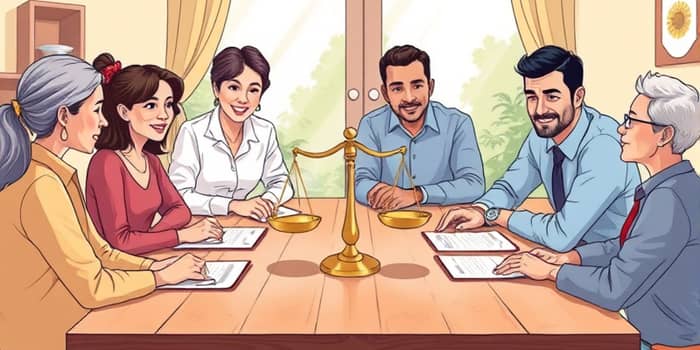
Inheritance distribution is more than a legal necessity; it is a profound act of care and foresight that shapes family legacies.
At its core, it involves dividing assets, rights, and obligations from a net estate, which is the total assets minus debts, to achieve fairness among heirs.
Striking a balance between equity and efficiency is crucial to prevent conflicts and ensure a smooth transition, making it essential for every family in Spain to understand and plan carefully.
Understanding the Spanish Legal Framework
Spanish inheritance law, governed by the Civil Code, provides a structured approach to distribution that emphasizes both equity and legal order.
The system is built on the concept of thirds, which divides the estate into three equal parts to balance forced heirship with flexibility.
- The strict legitimate share, 33% of the net estate, must go equally to children or descendants, ensuring baseline equality.
- The improvement share, another 33%, allows for favoring certain heirs without disrupting overall fairness, such as providing extra support.
- The free disposal share, the final 33%, can be allocated as the testator wishes, offering room for personalization and efficiency.
In cases without a will, intestate succession applies, where heirs are determined by a hierarchy starting with children, promoting an equitable split by default.
This legal structure underscores the importance of planning to align with Spanish Civil Code articles 1061-1062, which detail principles of qualitative and quantitative equality in lot formation.
Steps for Equitable and Efficient Distribution
A systematic approach is key to navigating inheritance distribution without delays or disputes, blending legal requirements with practical wisdom.
For example, with a net estate of €150,000 and three heirs, each receives €50,000 in value, either through assets or cash adjustments.
This process highlights how prevent family conflicts through meticulous preparation and open communication among all parties involved.
Methods of Distribution
Various distribution methods exist to cater to different family dynamics and asset types, each with its own balance of equity and efficiency.
- Direct adjudication with compensation assigns assets of equal value, with cash payments to balance any discrepancies, ensuring quick resolution.
- Sale and price distribution involves selling indivisible assets, like a family home, and dividing the proceeds, which is efficient for liquidating complex estates.
- Co-ownership or proindiviso allows heirs to jointly own properties, enabling future sales or rental income, ideal for preserving sentimental value.
- Rotational use applies to sentimental items, with heirs taking turns in possession, fostering shared memories without conflict.
- The counter-partitioner method requires agreement from at least 50% of heirs before a notary, binding even dissenting parties to streamline the process.
- Judicial distribution, as a last resort, involves a judge overseeing inventory and lot formation under civil procedure law, useful for breaking deadlocks but often costly.
Choosing the right method depends on factors like asset divisibility and family harmony, emphasizing the need for tailored strategies for each situation to achieve both fairness and speed.
Mechanisms of Equity
To uphold fairness, Spanish law incorporates specific mechanisms that adjust distributions based on lifetime actions and heir needs.
- Collation imputes lifetime gifts to forced heirs into the estate, ensuring equal shares by accounting for prior advantages, which maintains quantitative equality across all beneficiaries.
- Undetermined improvements allow flexible allocation of the improvement share, prioritizing heirs with greater needs or contributions, enhancing distributive justice.
- Extrajudicial pacts enable private agreements and mediation, especially in fractured families, to resolve disputes amicably without court intervention.
These tools help families navigate complex emotions and histories, ensuring that distributions are not only legal but also perceived as just by all involved.
Efficient and Preventive Strategies
Proactive planning is the best defense against inheritance disputes, blending legal foresight with family dialogue to create a seamless process.
- Planning during life through detailed wills, anticipatory attribution like bare ownership with life usufruct, and collatable gifts sets clear expectations and reduces uncertainty.
- Communication and transparency involve sharing documents openly and formalizing agreements in partition deeds, which foster trust and reduce misunderstandings among heirs.
- Personalized options balance equal shares with adjustments for specific needs or incomes, using a hybrid approach for real distributive justice when circumstances vary.
- In community property marriages, 50% goes to the surviving spouse plus separate assets, simplifying distributions and honoring marital contributions.
By adopting these strategies, families can minimize costs and emotional strain, turning inheritance into a positive legacy rather than a source of conflict.
Common Conflicts and Practical Solutions
Inheritance often brings challenges, but with awareness and tools, families can overcome them to preserve relationships and assets.
- Disagreements over distribution can arise from vague appraisals; solution: use professional valuations and mediation to clarify values and preferences.
- Sentimental or indivisible assets, like heirlooms, may cause tension; solution: implement rotational use or temporary co-ownership to share access fairly.
- Dysfunctional families face higher risks of blockage; solution: rely on private pacts and solidarity wills to outline agreements in advance.
- Complete deadlock may occur; solution: consider judicial distribution as a last resort, though it should be avoided due to expense and delay.
These insights underscore that open dialogue and early preparation are vital to navigating the emotional landscape of inheritance, ensuring that efficiency does not come at the cost of family bonds.
Ultimately, the art of inheritance distribution lies in harmonizing legal precision with human compassion.
By embracing equity through careful lot formation and efficiency via streamlined methods, families can honor legacies while building a foundation for future harmony.
Start planning today to transform this process from a potential burden into a meaningful celebration of life and love, ensuring that every heir feels valued and every asset is managed wisely.
Referencias
- https://www.javaloyeslegal.com/blog/repartir-herencia-partes-iguales
- https://arquitasa.com/repartir-herencia/
- https://notariaiglesias.com/herencias-claves-para-una-gestion-eficiente-y-sin-conflictos/
- https://hereditasabogados.com/herencias-familias-desestructuradas/
- https://toscanoabogados.blog/2024/09/20/la-distribucion-equitativa-de-la-mejora-de-la-herencia-un-enfoque-en-la-igualdad-de-los-coherederos/
- https://www.r4.com/inversion-para-todos/como-se-reparte-una-herencia-en-espana/
- https://mslegal.es/abogados-sevilla-derecho-sucesiones-colacion-particion-hereditaria-mecanismos-equidad-entre-herederos-forzosos/
- https://www.finect.com/usuario/Josetrecet/articulos/8-consejos-planificar-herencia
- https://abogadosherenciasmurcia.es/repartir-herencia-partes-iguales/
- https://www.abogadoamigo.com/particion-herencia/
- http://www.planartus.com/es/como-dividir-la-herencia-entre-los-hijos-por-partes-iguales-o-compensando-segun-sus-ingresos/
- https://www.martinezcardos.es/los-tercios-de-la-herencia-legitima-mejora-y-libre-disposicion-guia-completa-del-sistema-legitimario-espanol/
- https://www.eliasymunozabogados.com/blog/reparte-herencia-espana
- https://www.legaltoday.com/practica-juridica/derecho-civil/civil/colaciones-hereditarias-principio-de-equidad-de-los-legitimarios-2025-01-16/